
Montgomery County Bench Warrants Explained
Most people say "bench warrant." It means a judge has ordered an arrest after someone missed a required court obligation. Montgomery County records often say "capias" or "capias to show cause" instead. The label and the next step depend on the court, the notice, and the case. Common triggers include a missed appearance, an alleged violation of release conditions, or failure to follow an order. A missed date does not always produce the same result. The court may set a new date, issue process, or take another step the rules allow.
Montgomery County Bench Warrant Terms
A capias is Virginia's word for court process that directs an officer to bring a person before the judge. A "capias to show cause" asks that person to explain alleged noncompliance. "Recall" means the process is withdrawn. "Quash" means the Montgomery County court sets it aside.
- FTA
- Failure to appear at a required setting. Its legal effect depends on the case and notice.
- Capias
- A court-directed order for arrest or appearance before the court.
- Recall
- Withdrawal of process by the authority that issued it.
- Return
- The service record showing what an officer did with the process.
Ask the clerk in those exact words. "Bench warrant" is casual talk, and the Montgomery County docket may say capias.
How Montgomery County Bench Warrants Are Issued
Issuance starts with a judge, not the clerk. The court acts after a missed setting, an alleged violation, or another event that calls a person back to Montgomery County court. A clerk can explain the docket and filings. The clerk cannot decide whether to recall a capias. Virginia law treats some failures to appear as a separate offense, depending on the facts and the charge. Authorized staff then enter the process through restricted systems. The Sheriff's Field Operations unit serves court-issued capiases and other arrest documents in Montgomery County. The public OCIS view may show a case event. It does not show every entry, return, or service detail, and the Virginia failure-to-appear statute describes possible consequences without making every missed hearing lead to an identical warrant.
An FTA Can Create a Separate Case
One missed court date in Montgomery County can ripple into three places. It affects the original case, and where the law applies it can create a separate failure-to-appear charge. It can also bring bond consequences or a new setting. Do not infer the result from the missed date alone; the actual record and notice control. Montgomery GDC handles adult traffic and misdemeanors. Its traffic/criminal clerk answers at 540-394-2086. Circuit felony files go through the Circuit Clerk at 540-382-5760, option 7. JDR matters go to 540-382-6999, with confidentiality limits. Read the case event, then ask the issuing clerk whether process issued and what filing or appearance is required, because a payment portal is not a capias-recall service.
Bench Warrants and Arrest Warrants Compared
Both can land a person in custody. A Montgomery County bench warrant or capias usually follows a court event, while an arrest warrant follows a sworn complaint and probable-cause review. The issuing court's order controls the response.
| Feature | Bench warrant or capias | Arrest warrant |
|---|---|---|
| Trigger | Missed appearance or alleged noncompliance | Sworn complaint and probable cause |
| Case link | Often an existing case or court order | May start a criminal case |
| Public label | Capias or capias to show cause | Arrest warrant or related process |
| Next step | Ask issuing court about hearing, motion, or bond | Confirm order and release procedure |
The records may use terms that differ from the phrases people search online.
The GDC Bond Calendar Is Not a Walk-In Window
Montgomery General District Court sets jail arraignment and bond-hearing blocks on Tuesdays and Wednesdays from 9:40 to 10:30 a.m. That block is a calendar item. It is not a Montgomery County warrant-clearance counter, and it does not promise that anyone can appear without notice. The county has no universal bond amount. No walk-in surrender hour or standard recall fee exists. Ask the Montgomery County court or magistrate where the case must be handled, what records to bring, and whether counsel should file a motion first. Check the official Montgomery GDC calendar and contact page before you drive over. Times and procedures can change.
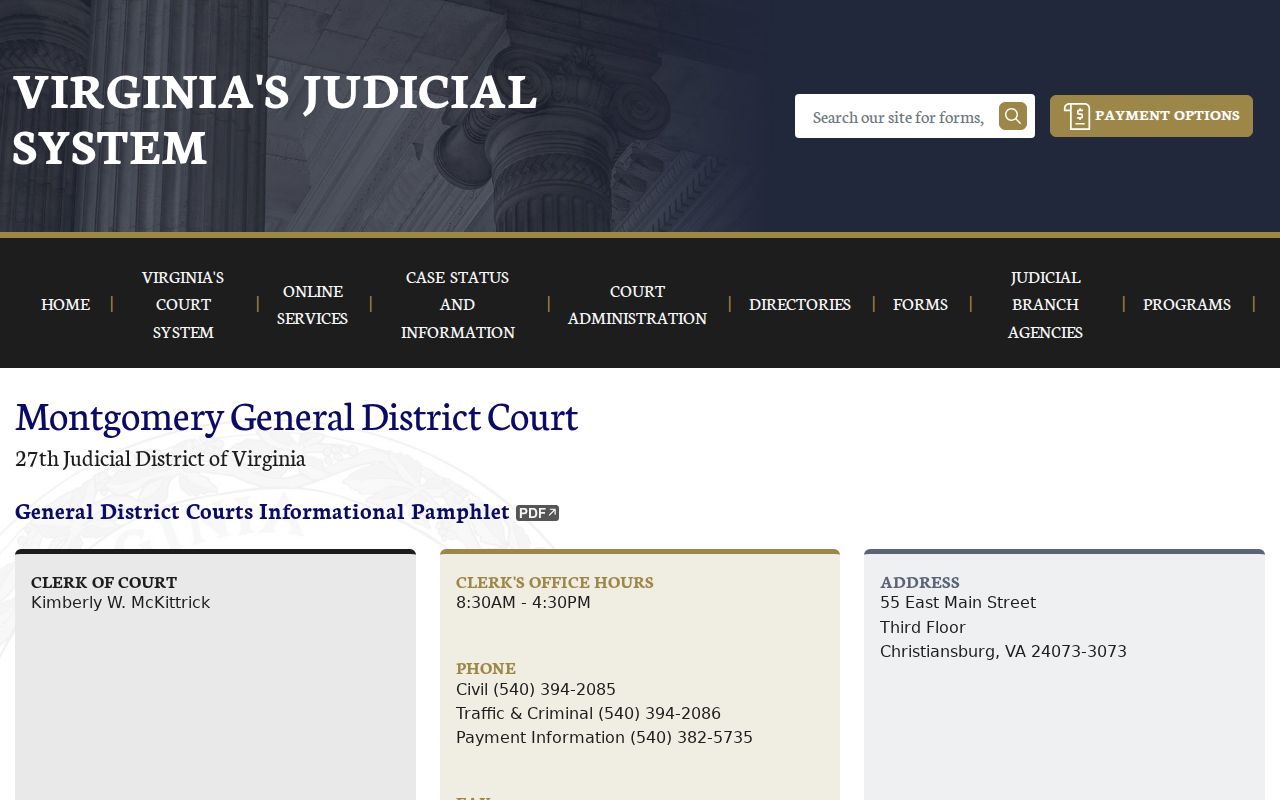
The court schedule gives a public contact and calendar, not an individual warrant determination.
Resolving a Montgomery County Bench Warrant
Ask the issuing court what procedure is available. Depending on the order, the next step could be a new date, a motion to recall or quash, an appearance, a bond decision, payment, or a lawyer's help. No single Montgomery County process fits every case. Circuit, GDC, and JDR each run their own dockets.
- Find the court, case number, and event that led to the process.
- Call the issuing clerk and ask what filing or appearance is required.
- Speak with a Virginia attorney about a motion, surrender, or bond question.
- After court action, request the docket entry or order showing what changed.
Caution: Do not ignore a missed-date order or rely on an old search. Confirm the court’s current instructions before going anywhere.
Montgomery County Bench Warrant Bond Questions
Virginia allows release on unsecured or secured bond and on conditions the court sets. A secured bond may involve cash or sureties. The amount and payment route are case-specific. Montgomery County publishes no countywide bond schedule and no payment counter window for every warrant. The Sheriff's corrections page covers jail operations and visits, not a bond office. Do not confuse a jail arraignment block with visitation hours. Ask the clerk or magistrate where a bond is accepted and what payment or surety the actual order allows. The statewide Virginia Magistrate Manual explains bond types. It sets no Montgomery County amount.
Finding the Court That Issued the Warrant
Montgomery County splits its court business across three levels. Circuit Court holds felony records, the GDC handles adult misdemeanors, traffic, preliminary felony proceedings, and many town ordinance cases, and JDR covers juvenile and domestic-relations files. Virginia magistrates serve a separate probable-cause and initial-bail role. Call the clerk that matches the case. Circuit: 540-382-5760, option 7; GDC traffic/criminal: 540-394-2086; JDR: 540-382-6999. Questions about service go to the Sheriff at 540-382-6915. The Circuit Clerk's Office sits in Suite 1 at 55 East Main Street. The courthouse screens every visitor and stores no prohibited property.
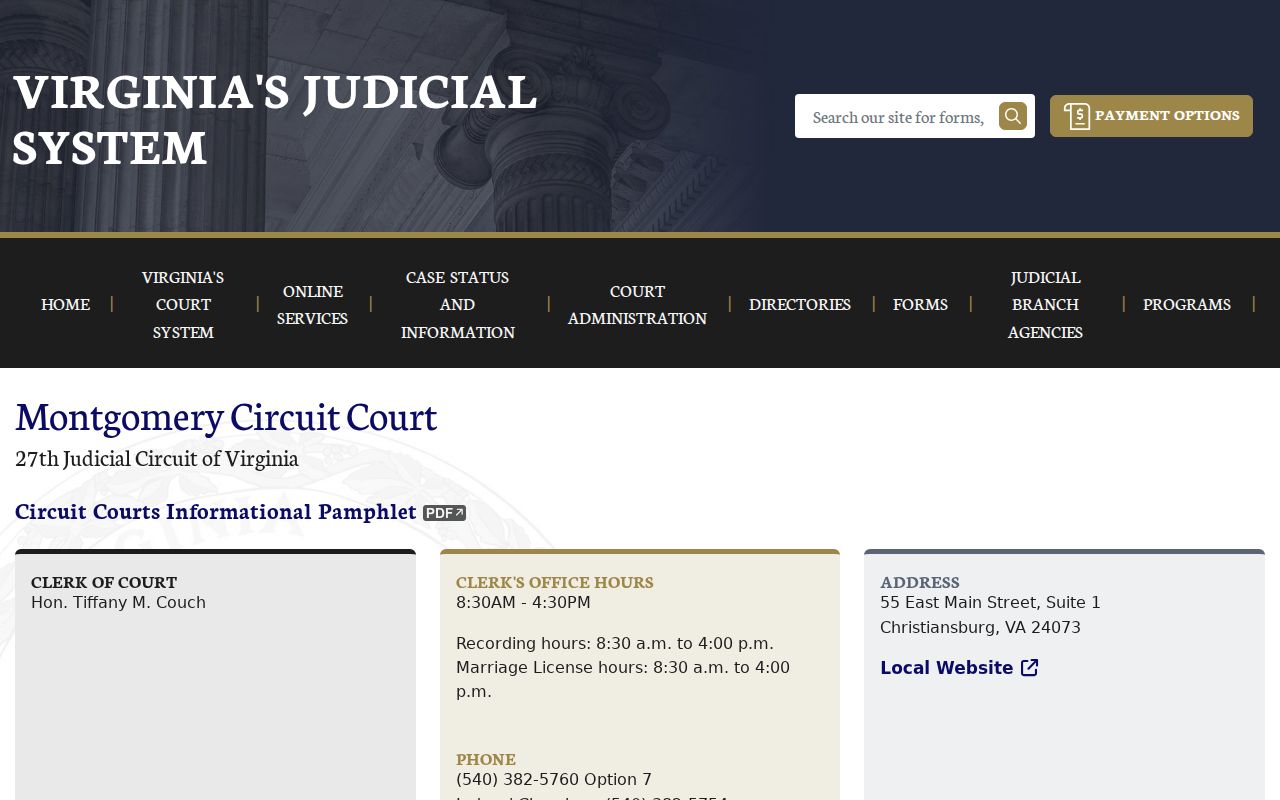
The Montgomery County Circuit Court page can help you identify the felony court route; it posts no public warrant roster for browsing.
Courthouse Security for Montgomery County Warrants
Every visitor to the Montgomery County Courthouse at 55 East Main Street passes through Sheriff screening. Prohibited items include cell phones, smart watches, cameras, knives, mace, scissors, box cutters, and lighters. None are stored on site. Call ahead if you need one for another purpose. There is no published parking plan. Nor is there a warrant-specific counter schedule, so confirm the floor, suite, and time with the clerk before travel. For a full county route, use the Montgomery County warrant overview.
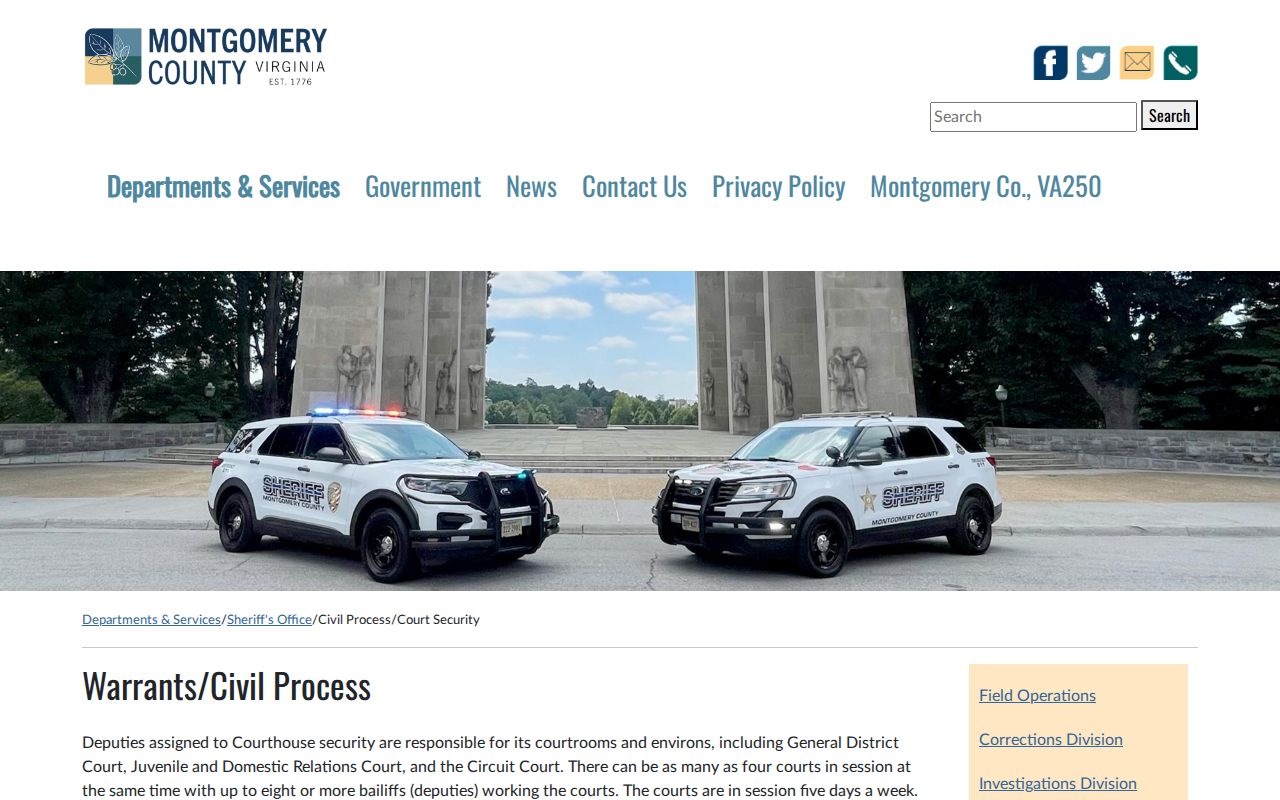
Courthouse security steps prepare you for the visit itself; they cannot tell you whether a Montgomery County warrant exists.