
Montgomery County Arrest Warrants Explained
An arrest warrant authorizes custody only after the required legal review. Virginia Code §§19.2-71 and 19.2-72 set out who may issue criminal process and how a sworn complaint plus a probable-cause finding supports the order. A judge or magistrate may be the issuing official in Montgomery County, depending on the matter. There is no public arrest-warrant roster or warrant-number search here. OCIS can locate an open adult case, but a public case result will not expose every restricted entry or confirm whether a warrant remains executable.
Montgomery County Warrant Issuance Process
Every Montgomery County warrant begins with a complaint or affidavit. That sworn information goes to an authorized official, who reviews it and decides whether legal grounds support a warrant or some other process. Police may request the order. The issuing court or magistrate still controls it.
- A complaint or affidavit is presented under oath.
- An authorized judge, clerk, or magistrate reviews probable cause.
- If issued, authorized staff transmit or enter the process in the proper system.
- The Sheriff or another officer may serve it and return the result.
- The person is brought before a magistrate or court for the next required action.
The public court page for a Montgomery County case may not show the affidavit, entry, service, or return at every stage.
Inside a Montgomery County Arrest Warrant
A Montgomery County court record can supply identifiers a clerk needs to find the file. It may not reproduce the warrant document itself or restricted law-enforcement data. The public OCIS screen has no local warrant number format and no universal bond field.
| Case number | Court identifier; use the number from the notice or clerk. |
|---|---|
| Party name | Shown only when the case is open to public inspection. |
| Charge | Offense description or code, if available in the public view. |
| Issuing authority | Court level and locality; ask the clerk if the judge is not named. |
| Bond or release | Appears only if the order is published; amount is case-specific. |
| Service return | May be held by the serving agency rather than displayed in OCIS. |
A label like arrest warrant in a Montgomery County file means little alone. Read it with the court, the date, and the case events around it.
What OCIS Leaves Out of a Warrant Record
OCIS covers public court cases only. Virginia's VCIN, NCIC, and e-Magistrate are restricted criminal-justice systems that may hold warrant data no public search will show. The public screen has no service-status, active-warrant, or bond filter. Juvenile records, sealed material, investigative records, and federal process all follow separate access rules. A missing result proves nothing either way. A Montgomery County clerk can explain the public court file but cannot disclose restricted system information or give a legal opinion. For an adult matter, search by name, case number, or hearing date and select Montgomery County. The OCIS landing page lists the public route and its current controls.
Serving Arrest Warrants in Montgomery County
Montgomery County Sheriff's Field Operations says its warrant deputies serve criminal warrants, court-issued capiases, juvenile arrest orders, and other arrest documents. The unit works with Christiansburg Police, Blacksburg Police, Virginia Tech Police, and Virginia State Police. Keep one thing in mind. The agency that serves an order may not be the court that issued it. After service, an officer records a return and the person goes through the required magistrate or court process, where release conditions and bond are decided under Virginia law. The county publishes no set processing window or bond amount, so confirm the location and procedure before you travel. The Sheriff's main office sits at 1 East Main Street in Christiansburg, and its official warrant-unit description also notes interstate return work.
Montgomery County Warrant Deputies and Partner Agencies
Service in Montgomery County can fall to the county Sheriff, town police, campus police, or state police, depending on jurisdiction and the order. Sheriff's warrant deputies are dually sworn as Deputy U.S. Marshals. That status is public record of their role. It creates no countywide roster and no shared status screen across agencies.
Montgomery County Sheriff’s Office
Field Operations serves criminal process and court-issued capiases.
1 East Main Street, Christiansburg, VA 24073
540-382-6915
Need a Montgomery County incident report? Call the police agency that handled it. For the case order, call the issuing court clerk.
Comparing Arrest, Summons, and Bench Warrants
These terms are different directions from a court or issuing official. A summons orders a person to appear. An arrest warrant authorizes custody under its terms. A bench warrant or capias in Montgomery County usually follows a missed court setting.
| Process | Starting point | What it directs |
|---|---|---|
| Arrest warrant | Sworn complaint and probable cause | Officer may take the person into custody |
| Summons | Authorized charge or proceeding | Person must appear as directed |
| Bench warrant or capias | Missed appearance or alleged noncompliance | Person may be brought before the issuing court |
One call to the Montgomery County clerk can confirm which order the court issued, since a case result alone rarely shows the whole process.
Federal Warrants in the Western District
Federal cases sit apart from Montgomery County Circuit, GDC, and JDR dockets. Montgomery County falls in the Western District of Virginia. Federal court records run through PACER, and fugitive matters may bring in the U.S. Marshals Service and the Central Appalachian Regional Fugitive Task Force. Federal dockets can be sealed or access-limited. A state OCIS search cannot confirm a federal warrant. The district also warns of scams. Its courts never demand urgent payment by phone or ask for Bitcoin or gift cards, so verify any federal notice through the official court or Marshals contact. The Western District court site carries PACER access and current scam notices, and its Roanoke office serves the district's counties.
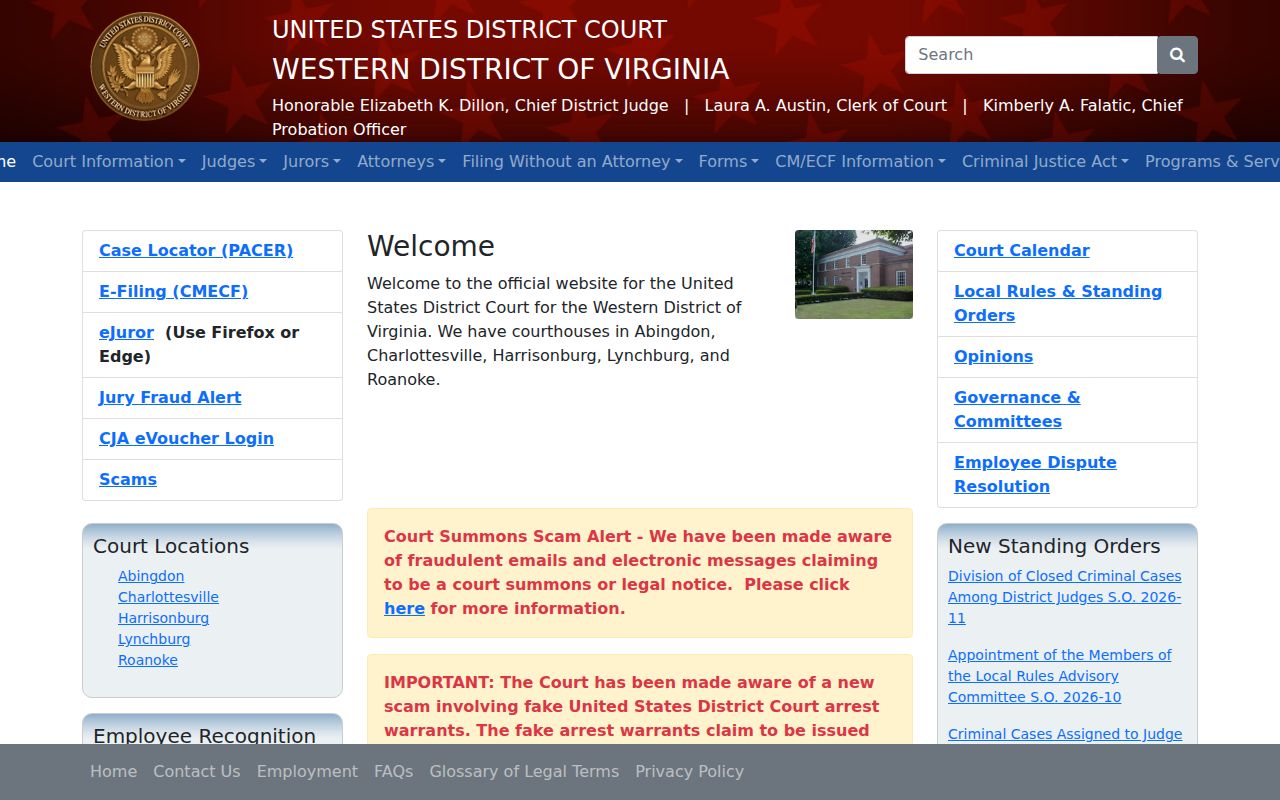
Federal case information follows a different court path from county process.
If There's an Arrest Warrant for You
Never act on a message or an old search result alone. If OCIS shows an eligible adult matter, use it to identify the case and issuing court. Then call the Montgomery County clerk or Sheriff's Office and ask what procedure applies. A lawyer can contact the court for you and advise on an appearance, surrender, bond, or a motion to recall or quash.
Important: Confirm the issuing authority and current instructions before you travel or pay. No countywide walk-in surrender time or standard bond amount is published.
Hold onto every court notice, case number, and hearing date. Ask the clerk how the court records the result once an order changes. A bond decision settles release only; it does not end the case. The Montgomery County warrant overview lays out the local clerk and Sheriff routes.
Montgomery County Warrant Forms and Records
Virginia's forms library covers the Criminal Complaint DC-331, the Arrest Warrant DC-332, and the Capias DC-338. Montgomery County publishes no warrant-status form of its own. No local motion-to-recall packet exists either. Use the current state forms. Skip that old download. A records request should name the office, the existing record, and the date range: the Montgomery County clerk holds court files, while the Sheriff or the originating police agency may hold a service return, incident report, or aggregate count. Virginia FOIA never requires an office to create a new warrant list. The county FOIA instructions explain the five-working-day response rule, possible deposits, and redactions for protected information.
Montgomery County Warrant Confirmation Steps
Start at the right counter. The Circuit Clerk sits at 55 East Main Street, Suite 1, and handles felony criminal files. GDC traffic and criminal matters are on the third floor of the same courthouse. JDR is in Suite 2A. Access there is protected. The Sheriff works from 1 East Main Street and keeps its main office open 24 hours every day. Each Montgomery County office plays a distinct role, so ask the clerk which counter and hours apply before you visit. Leave restricted items behind. The courthouse bans phones, smart watches, cameras, knives, mace, scissors, box cutters, and lighters, and it stores none of them for you.